

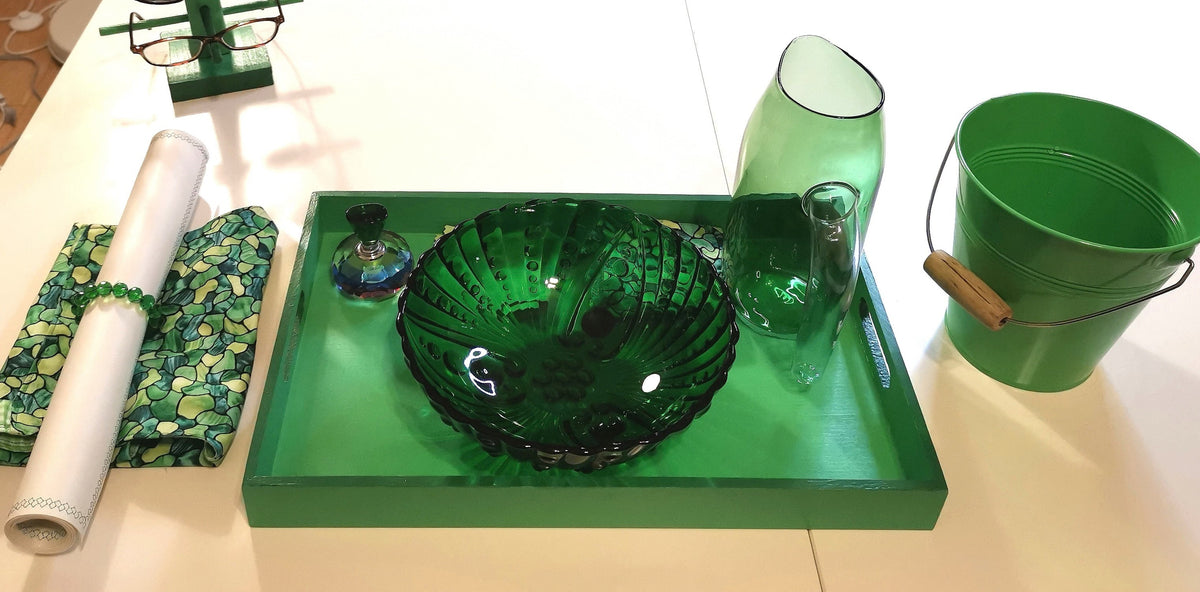
Every marketplace has an origin story. The Shared Environment starts with a green metal bucket.
"The Shared Environment will multiply the opportunities that Montessorians are already working so hard to offer."
The Buckets
Co-founder Staci Hedlund was still in Montessori training when she ran into the problem that would eventually become a company. She was building a set of practical life materials and needed something absurdly specific: a durable, beautiful, green metal bucket, sized just right for a three- to six-year-old's hands. When Guides create materials, the items they need can be incredibly specific.

The only place she could find one was a big online marketplace, and they sold the buckets in sets of six.
“What am I going to do with five extra green buckets? I wish I could offer them to other Montessorians, and then they wouldn't have to buy six green buckets!” Staci thought.
That small, oddly specific frustration and the gap between what Montessori educators actually need and what the market makes easy to find became the seed the whole marketplace grew from.
What's in a Name
The Shared Environment borrows its name straight from Montessori vocabulary, and both founders come at that phrase from their own angle.
For Alex, it's about a shared purpose rather than a shared space. "It's about creating a place where everyone contributes to a singular purpose: making Montessori education more accessible by improving availability of materials," he says. "The more we can pool together our expertise, crafts, and energy, the more impactful this marketplace can be in serving the needs of guides and families. If sourcing materials for an environment can become simpler, we can help remove barriers for children to thrive in the method."
Staci, a trained Guide herself, brings a personal take and an invitation to interdependence among the people doing this work. "We're all out here preparing and maintaining environments," she says. "How can we be most effective in that work? I sew, you weave, someone else is a painter. You know a granddad who makes chowkis and your friend's cousin is a ceramicist. If we can pool our efforts in service of children, the world benefits."
Staci thinks often about the World War I veterans who made Montessori materials in the method's early days, and how healing that work might have been for them. "The Montessori method is for all of us, adults included," she says. "We can all learn new ways of cooperating in service of a more peaceful future."
While the starting points differ, accessibility, interdependence, and the children are at the heart of it.
A Partnership of Different Minds
The Shared Environment is a co-founding story as much as a company story, and it works, both founders say, because of how little Staci and Alex's backgrounds overlap.
"Staci brings the knowledge and expertise of the method that highlights where there are challenges, while I help shape the processes and systems that can make the solutions to them feasible," Alex says. "We balance each other in what we bring to the table — which is why being co-founders is so crucial."

Staci describes the same dynamic from the inside of it. "Alex and I can produce more ideas in one conversation than can be realized in a decade. He's a tech consultant, and I'm a Montessori guide, so we have approached this work from really different points of view. We challenge each other's beliefs and assumptions and push each other to evaluate different approaches to solving the same problems. Sometimes I think about the fact that he studied Chemistry and I studied Biology — we differ substantially, but we overlap in meaningful ways." She's quick to credit what he's brought beyond the technical build: "He has a strong mind for strategy and a generous heart for service. He's principled and sincere."
That partnership was tested early by the sheer volume of new ground under their feet — new domains, new systems, all learned from scratch and under pressure. For Staci, it was the pace as much as the volume: "I typically like to learn under the same conditions we offer children — unpressured and peaceful and one thing at a time. A tech startup is not that. Like, not ever."
Protecting the Method While Opening the Door
The tension between running a business and staying true to Montessori's meaning is the question both founders feel most deeply.
Alex frames it as a design principle: "It's about focusing on the core purpose of The Shared Environment, making authentic materials more accessible for everyone." That philosophy shapes the marketplace's mechanics, not just its marketing. The platform has no aggressive sales tactics designed to pressure customers into buying, and no extra fees layered onto sellers beyond what's necessary to run the platform. The aim, on both sides of any transaction, is a calmer experience than the rest of the market offers — a marketplace built, as Alex puts it, "to serve the entire community as authentically as we can."
Staci reaches further back, into the history of the method itself. "Globally, we're in a very specific moment in the history of the Montessori method. Social media has offered Montessorians a huge opportunity to share our knowledge and to advance the world toward a more peaceful future. As a Montessorian, that makes me feel joyful and hopeful."
But that popularity comes with risk, she says. "There are a lot of companies that have tuned into the effectiveness of using 'Montessori' as a keyword or a label for products that are not related to the method at all. The world is at risk of losing the definition of the Montessori method entirely... the general impression becomes, 'Montessori is wooden toys.'"
She draws a direct line back to Dr. Montessori's own experience with early global fame, and the reason AMI (Association Montessori Internationale) exists at all. "People were trying to replicate Dr. Montessori’s outcomes without understanding her discoveries and her method. Without the benefit of knowledge, there was a real risk of harm to the development of the children in their care. It's one thing to create the conditions that enable a three-year-old to write of their own volition, and quite another to try to force-feed a three-year-old writing skills," Staci shares.
Dr. Montessori founded AMI in 1929 to standardize teacher training, prepared environments, and materials, a structure that has let millions of children benefit from her discoveries over the past 97 years. Staci sees The Shared Environment's curated marketplace as doing similar work for this moment: "We are responding to the interest in materials by making it easy for anyone in the world to access materials that are aligned with Dr. Montessori's descriptions. Absolutely everyone can visit The Shared Environment and leave knowing more about the Montessori method than when they arrived. The curated marketplace is democratizing one of the greatest discoveries of human history, and doing a small part to protect those discoveries in the process."
An Audience That Kept Growing
When Alex pictured who The Shared Environment was for, he saw the field from a global view. He saw, “the guide whose passion for nurturing children's development; the family who are working to support their child outside of the environment; and the areas that aren't currently served by a Montessori school but could be. I saw the potential of what the world could — and, hopefully, will — look like when there is truly a one-stop-shop for every Montessori environment's needs."
Staci's picture started narrower and grew from lived experience. In the beginning she “imagined people coming to The Shared Environment for materials, guides I knew, and the friends I met in training. Then, when I began practicing as a guide and as an administrator, I found that I was constantly sending families lists of products to support family life. Not every snowsuit is equally easy to put on independently. Not every lunchbox can be managed by a two-year-old. Some products for home life are more supportive than others, and align more closely with what we know of child development."
"I'd say in the truest sense of lifelong learning," she says, "the more I have experienced of the Montessori method, the broader The Shared Environment's intended audience has become."
What the Sellers Taught Us
Some of the company's most defining commitments came from listening to the first people who joined the marketplace. The Shared Environment's very first Seller was Essential Montessori, run by Lea Shell and JJ Sylvia — makers of hand-made mobiles and heirloom-quality wooden materials dyed with locally grown produce.
What stuck with Staci wasn't the craftsmanship alone, but what Lea and JJ described about selling in a well-known online crafts marketplace. "In that space, they are scored on everything they do, and they're even scored on some things other people do, over which they have no control. Those scores affect the placement of their company's products in search results. Essentially, they are required to be permanently hustling for the algorithm."
"It makes me sad to think of their energy being wasted by a gamified platform," Staci says. "It was their perspective that caused us to explicitly commit to never controlling people in that way — to trusting Sellers to be intrinsically motivated to run their own businesses well."
The Long View
If you ask each founder what success looks like a decade out, you’ll get two different measures pointing at the same outcome.
For Alex, it's quantitative. "My hope is that The Shared Environment's growth and success will be mirrored in the expansion of Montessori around the world. The way I truly will measure the impact we've had — and what success means to me — is seeing the number of Montessori schools be significantly greater in five or ten years. That will signal that we've been able to make sourcing materials more accessible and, in doing so, removed some of the barriers to running and establishing the schools themselves. More families will be able to support their children through the method, and the world will undoubtedly become a more peaceful place."
For Staci, it's qualitative. "My hope is that we'll see guides' mental health and work-life balance strengthened. With guides' improved quality of life will come classroom careers lasting longer, the staffing crisis ending, more adults going to training and beginning classroom careers, and more children having the opportunity to be in Montessori environments. More families making homes that support functional independence and peace."
She closes with the line that, for her, sums up the whole project—Dr. Montessori's own words: "I did not invent a method of education. I simply gave some little children a chance to live." Staci’s deepest hope is, "The Shared Environment will multiply the opportunities that Montessorians are already working so hard to offer."
Share:
Easiest Edible Flowers to Grow: Marigold & Nasturtium Tips
Out the Door with Grace