

By Leonora Shell, COO of Essential Montessori
Kicking off this series I wanted to pull together a post on why it's important to provide the appropriately aged Montessori materials at the right time. In the Montessori learning environment you might hear the phrases "sensitive period" or "absorbent mind" -- generally these refer to supporting a baby's growth and development through a prepared Montessori environment. One of the ways to do this is with Montessori materials. As with all children's products, all items need to be used under adult supervision. Montessori materials are a wonderful tool for supporting a baby's development from birth through the toddler years. However, as a baby grows and develops, their needs and abilities change, and the Montessori materials that are appropriate and engaging for them also evolve. In this introductory post, we will explore how Montessori materials and a baby's needs vary by age.
Birth to 3 Months
During the first few months of life, a baby's needs are primarily centered around basic physical needs such as eating, sleeping, and being held. However, even at this young age, Montessori materials can be used to support the development of the senses and promote early exploration.
 One of the most important Montessori materials for newborns is a Montessori mobile. Mobiles designed for this age are simple and made up of high-contrast images and black-and-white patterns to stimulate a baby's developing visual system. These mobiles should be hung low above the baby but out of reach, so they can focus on the patterns and images.
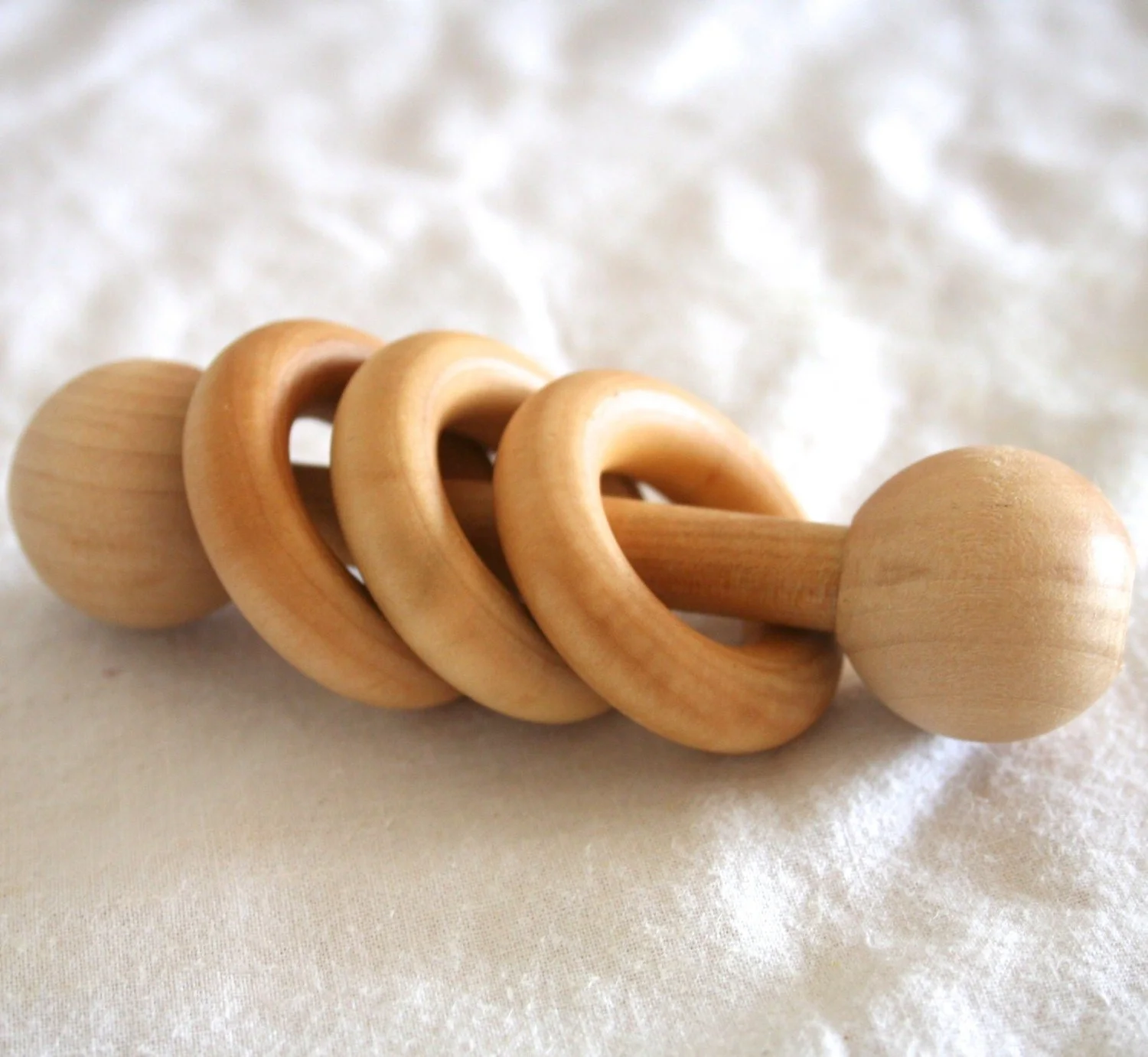
Another Montessori material that can be used for this age is a grasping material. Grasping materials can be hung low on a mobile or placed in a baby's hand to promote hand-eye coordination and the development of the grasping reflex. All of these are available in our 0-3 month bundle -- as parents striving for minimalism in our home it was important for us to make it simpler for new parents and caregivers to get what they needed without extra steps!
3 to 6 Months
Between three and six months, a baby's sensory awareness becomes more refined, and they become increasingly interested in exploring their surroundings. At this age, Montessori materials can be used to encourage exploration and support the development of gross and fine motor skills. Tactile mobiles are excellent to introduce at this age -- they are grasping and reaching and beginning to understand cause and effect.

One of the most important Montessori materials for this age is a Montessori mirror. A low, unbreakable mirror can be placed on the floor to allow a baby to explore their reflection and practice reaching and rolling. Additionally, grasping materials can be introduced with more complex textures and shapes to encourage exploration and manipulation. You can find what you need in our 3-6 month bundle, which contains grasping materials, musical materials as well as ones that roll and encourage movement. This is by far our most popular bundle of handmade Montessori materials as it spans several months of development.
6 to 9 Months
Between six and nine months, a baby's gross and fine motor skills become more refined, and they begin to develop a greater sense of independence. At this age, Montessori materials can be used to support the development of gross and fine motor skills, promote independence, and encourage exploration.

Additionally, a low shelf can be introduced to allow a baby to independently choose and explore a variety of Montessori materials. We created a quick tutorial on our Instagram on how to make a low, lightweight shelf for your little one. Alternatively a lightweight wood shoe rack or a similar shelf makes an excellent alternative. The shelf can be set-up earlier than this age, but really comes into use by the child rather than the adult during this stage. We love this age range and put together the 6-9 month bundle to support your child's needs at this age.
9 to 12 Months
Between nine and twelve months, a baby's physical abilities become more refined, and they become increasingly interested in the world around them. At this age, Montessori materials can be used to promote exploration, support language development, and encourage independence.

One of the most important Montessori materials for this age is a Montessori object permanence box. Object permanence boxes consist of a box with a hole and a ball or object that can be dropped in the hole and retrieved from the bottom. This material promotes the development of object permanence and problem-solving skills. Additionally, books with simple yet realistic pictures and labels can be introduced to support language development.
12 to 18 Months
Between twelve and eighteen months, a baby's cognitive abilities become more sophisticated, and they begin to develop a greater sense of independence and autonomy. At this age, Montessori materials can be used to promote independence, support language development, and encourage problem-solving.
One of the most important Montessori materials for this age is a Montessori practical life activity, such as pouring or spooning activities. These activities promote independence, concentration, and fine motor skills, and can be introduced in a structured and simple way.
In the coming weeks we will have posts for each month to further break down these recommendations for you! It has been a lot of fun and a huge feeling of nostalgia to go back and look at our own evolving Montessori environments from that time, the Montessori materials that we made for our own family and their own growth over the years. Our daughters are now 7 and 9, learning Latin and taking on the world -- I hope this is helpful for you!



Share:
Montessori From Birth: Month 1