

PHYSICAL PRODUCT
Subtraction Equations
Combines well with
Subtraction Equations
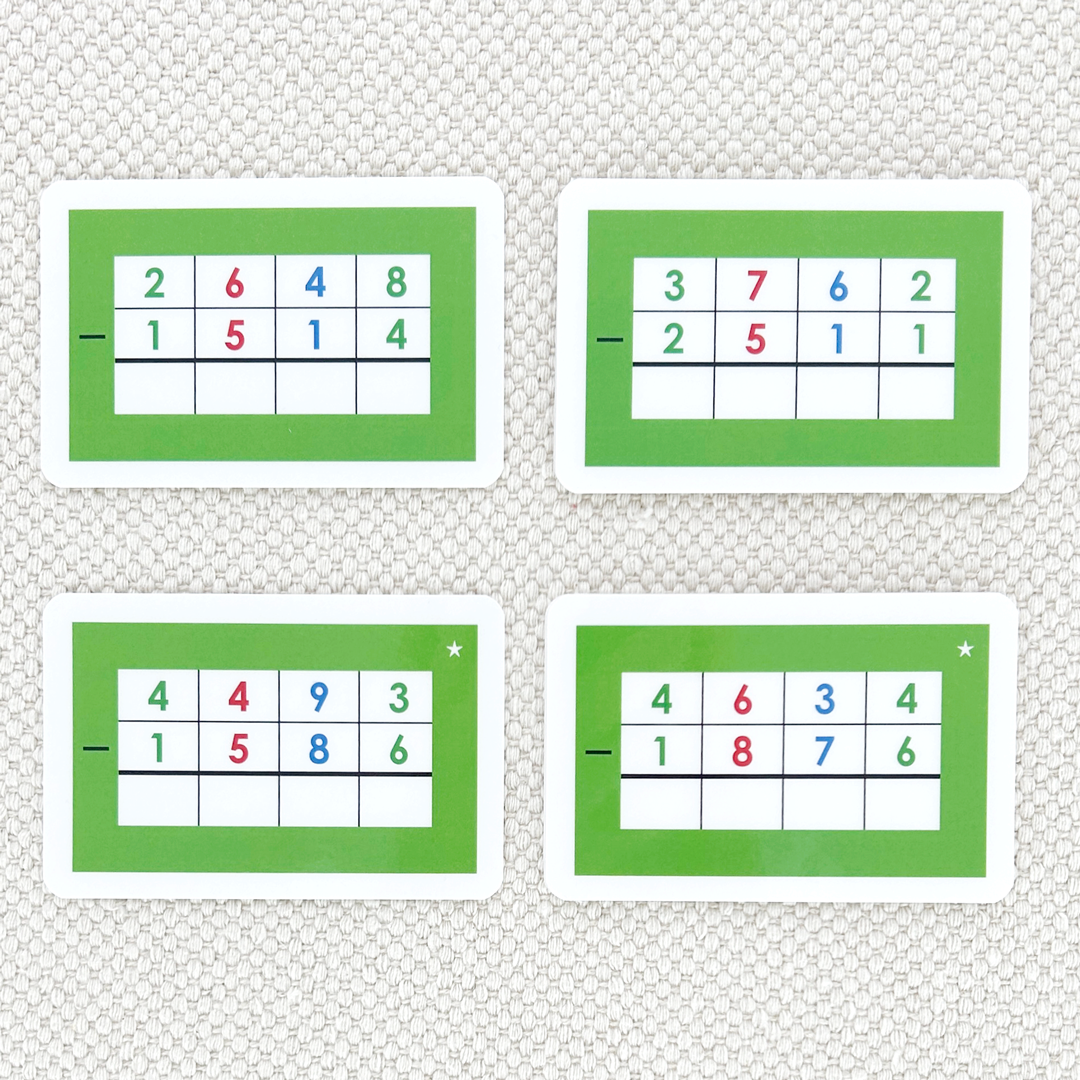
Our Montessori Subtraction Equations give students 16 prepared equations to solve independently with the stamp game, bank game, or other base ten materials. Every minuend and subtrahend has four digits, so students work with units, tens, hundreds, and thousands.
Half of the equations are static, and half are dynamic, with borrowing. Students build each equation, remove the subtrahend, and find the difference. If they're writing, they can then write the equation and answer in their own math journal.
What's included
- 16 equation cards: 8 static and 8 dynamic
- A small white star on each dynamic equation for easy reference
- Color-coded numerals, with a green border for subtraction
- No solutions on the cards
- Cards are approx. 4¼" x 2¾"
- Eco-laminated with a food-grade laminate and rounded corners
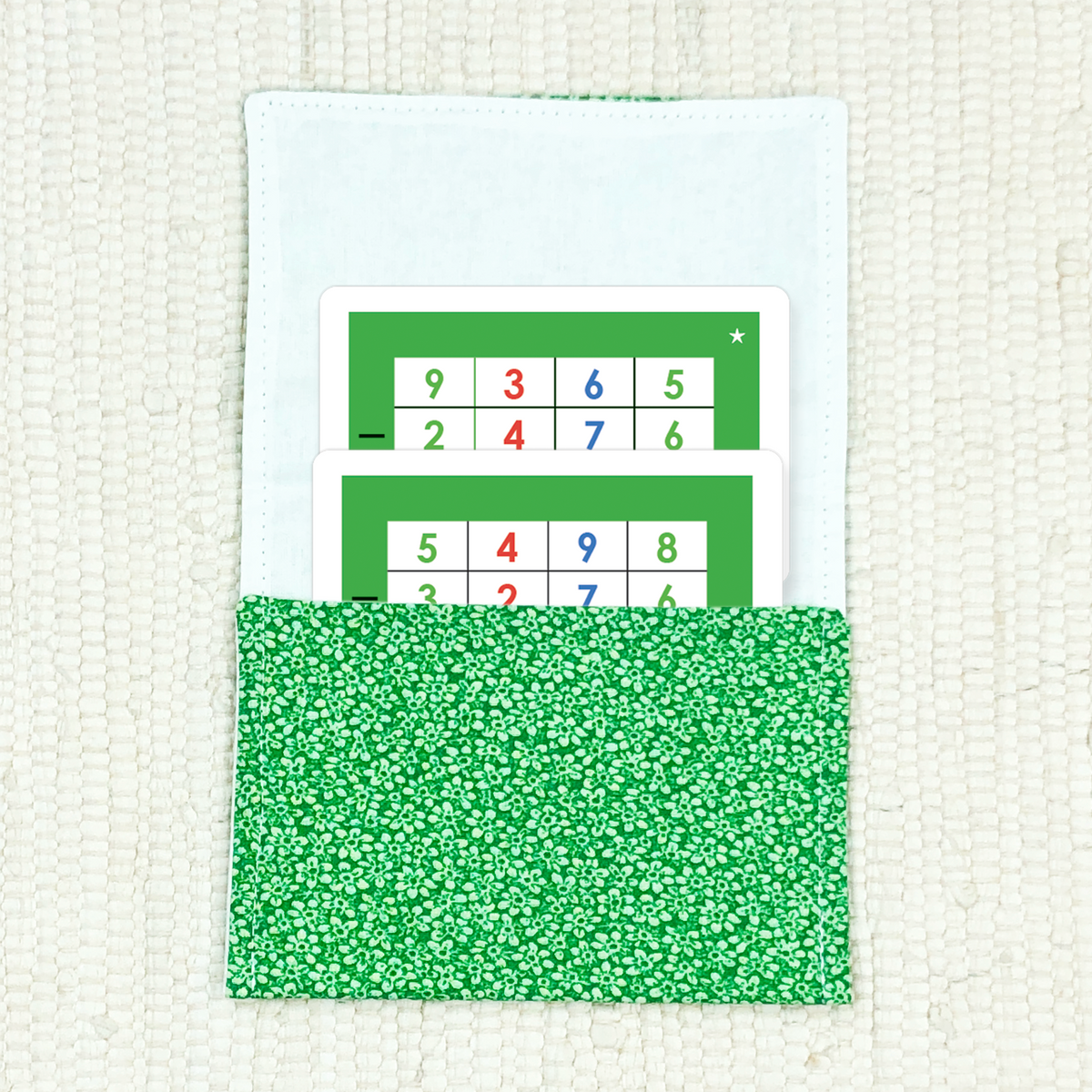
- Sturdy, clear reclosable bag for teacher storage
- Black and white equation master included (or download the printable equation master)
- Lesson plan included
Base ten materials, such as the stamp game or bank game, are not included.
Add a green medium cloth pouch for color-coded, student-accessible classroom display.
These cards are also part of our Math Equation Set.
Created by a Montessori teacher. Eco-printed in our rural New England office.
Made in the USA. CPSIA compliant.
Why use prepared subtraction equations?
Prepared equations let students work independently. A student can choose a card and start right away, without waiting for you to write a problem. Each time, they practice the same steps with the base ten materials, and they get to see what subtraction really does to a quantity.
How do you use subtraction equation cards?
For your first presentation, use the equation master to handwrite your own equation. Then, offer these prepared cards so students can solve problems on their own. The cards don't show solutions, so students find each answer with their materials:
- Lay out the minuend, the top number, at the top of the work area.
- Physically remove the subtrahend, the bottom number.
- Count what remains to find the difference.
Once students have experience with dynamic equations, make photocopies of the equation master so they can create their own math problems.
What is the difference between static and dynamic equations?
Static equations can be solved without any borrowing. Dynamic equations require students to borrow, such as exchanging a ten for ten units. Start with the static equations, then move on to the dynamic equations, which are marked with a small white star.
What comes after subtraction equations?
Next, students move on to our Short Division Equations.
What ages is this for?
Typically ages 4 to 9, once a student has been introduced to subtraction with base ten materials.
What is an album badge?
Trained Montessorians select every product in The Shared Environment. If the product fulfills the description in a presentation, it gets an album badge.
Album badges represent the analysis of trained Montessorians and do not indicate endorsement by an accrediting body. The album badging process and symbols are proprietary intellectual property of The Shared Environment.