




PHYSICAL PRODUCT
Botany "Parts of" 3-Part Set
Combines well with
Botany "Parts of" 3-Part Set
Our Botany "Parts of" 3-Part Set bundles four packets of 3-part reading cards, one each for the tree, leaf, dicot flower, and monocot flower. Each packet pairs real photographs of the plant and its key parts with matching word labels, so students read botany words like trunk, petiole, and stamens, match them to the photos, and check their own work with the control cards. This repeated, self-correcting practice builds reading fluency and connects new words to both their spelling and their meaning. Ages 5+.
Together, the four packets let students zoom in on a plant, from the whole tree down to a single leaf and then to its flowers. They can also compare the two great groups of flowering plants side by side: dicots, whose seeds have two seed leaves, and monocots, whose seeds have one and whose flower parts usually come in threes.
What's included
- Parts of the Tree (15 cards): a bonsai ficus and its branches, leaves, roots, and trunk
- Parts of the Leaf (30 cards): the leaf and its apex, axillary bud, base, blade, margin, petiole, primary vein, secondary veins, and stem
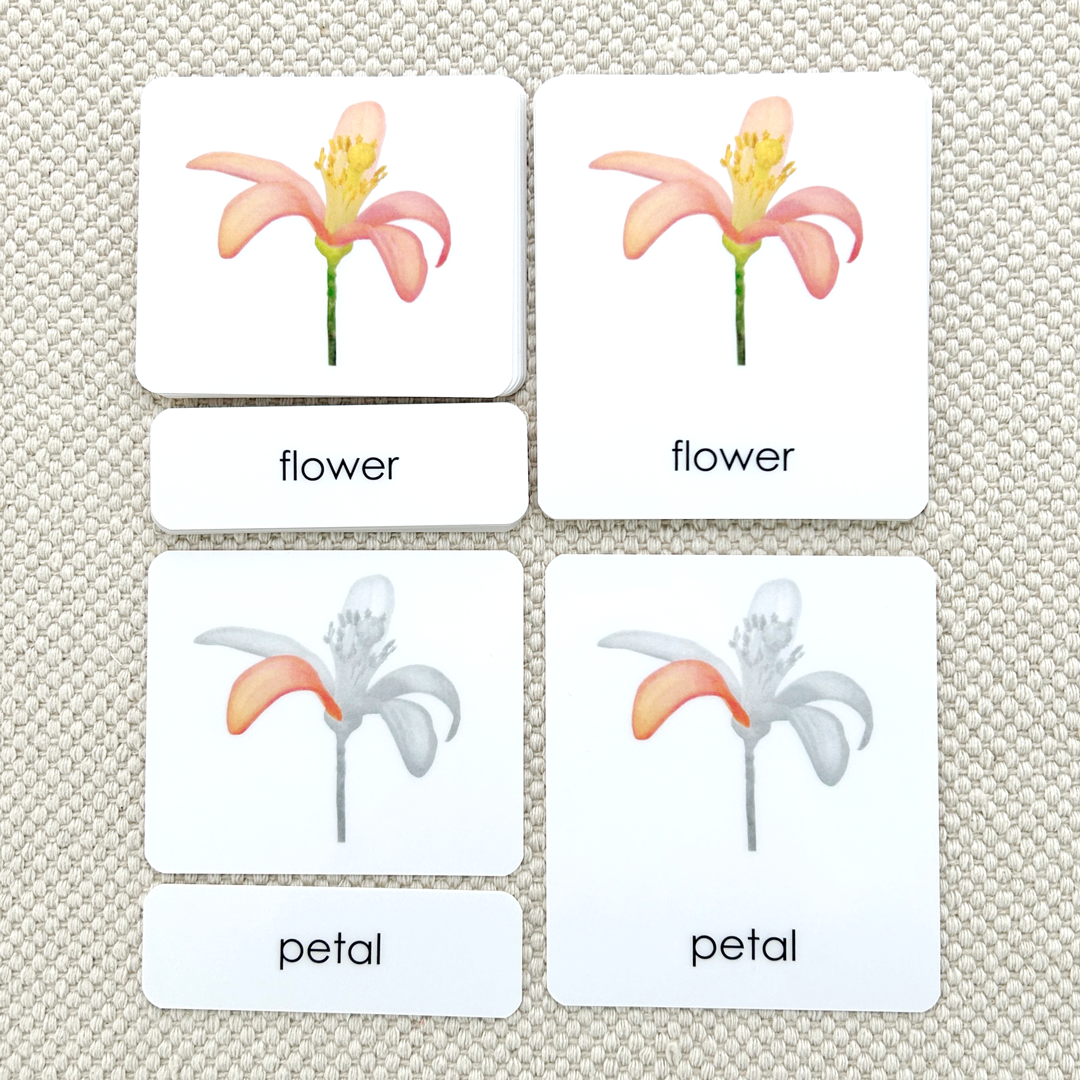
- Parts of the Flower (Dicot) (27 cards): a lemon flower and its calyx, corolla, perianth, petal, pistil, sepal, stamens, and stem
- Parts of the Flower (Monocot) (18 cards): a monocot flower and its key parts, including tepals and stamens
- 90 cards in all, each packet in its own sturdy, clear reclosable bag
- Eco-laminated with a food-grade laminate and rounded corners
- Cards are approx. 3¾" x 4¼" control cards, 3¾" x 3" photo cards, and 3¾" x 1¼" word cards
- Lesson plan included
Want the books, vocabulary cards, and definition cards too? Our "Parts of" Botany Bundle includes the complete build-a-book materials for all four plants, and our Botany Build-a-Book Bundle adds our Leaf Shapes materials.
Add on our 3-pocket cloth pouches (one per packet) for an elegant, child-accessible display solution.
Created by a Montessori teacher. Eco-printed in our rural New England office.
Made in the USA. CPSIA compliant.
Note: Photos may change from those pictured.
Why do 3-part cards matter for reading?
Three-part cards make reading practice independent. The control card lets students find and fix their own errors, which is how humans learn best, with no teacher correction required. Beyond that, remember that interest drives learning. Students who are interested in plants will choose these cards again and again, and that curiosity can carry even a reluctant reader through repeated reading practice. The cards also build vocabulary, part of the language comprehension side of reading in both Gough and Tunmer's (1986) simple view of reading and Scarborough's (2001) reading rope. By reading words like petiole and stamens now, a student will recognize and understand them when they later meet them in a science text.
How do you use the Botany "Parts of" 3-Part Set?
We suggest introducing the packets in order from whole to part: the tree first (it has the fewest cards), then the leaf, then the dicot and monocot flowers. For each packet, begin by using the photo-only cards to teach the names of the parts (via the three-period lesson), starting with the whole plant. Real trees, leaves, and flowers gathered outside make a wonderful companion. When students are stretching past phonetic reading, use all three parts: lay out the photo cards, read and match the word labels to the photos, and use the control cards to check for accuracy independently (no teacher help required). Once students know both flowers, lay the dicot and monocot cards side by side to compare them.
What ages is this for?
Typically Kindergarten (ages 5–6) and above. However, students of any age can benefit from these cards if they:
- Can read phonetically
- Are interested in plants, trees, flowers, or gardening
- Need practice reading
- Prefer self-correcting activities to teacher correction
What is an album badge?
Trained Montessorians select every product in The Shared Environment. If the product fulfills the description in a presentation, it gets an album badge.
Album badges represent the analysis of trained Montessorians and do not indicate endorsement by an accrediting body. The album badging process and symbols are proprietary intellectual property of The Shared Environment.